AI in Regulatory Writing: Improving Efficiency Without Compromising Quality
For pharmaceutical companies and CROs, the challenge is not simply to produce regulatory documents faster. It is to deliver clear, accurate and consistent content that supports regulatory review. Artificial intelligence (AI) can help with parts of that process, but efficiency must go hand in hand with scientific judgement and quality control.
Where AI can support your project
AI-assisted tools can support tasks such as preparing initial drafts, organising source information and flagging inconsistent terminology. Used appropriately, they may reduce routine work and allow writers to spend more time on scientific interpretation and review. The value depends on the task, the tool and the checks applied—not just the speed of generating text.
Why expert review still matters
A well-written regulatory document needs more than fluent language. It must accurately reflect the evidence, communicate limitations and remain consistent with related documents and applicable guidance.
AI-generated content can sound convincing while containing errors or unsupported statements. Experienced regulatory writers bring the scientific understanding and critical judgement needed to check outputs against source material and put findings in context. Responsibility for accuracy and interpretation remains with qualified professionals.
Protecting your information and document quality
Confidential clinical and commercial information requires careful handling. Any use of AI should align with your organisation’s data privacy, information security and intellectual property policies. Outputs also need verification against source data and current regulatory requirements. Technology should support a controlled writing and review process, not bypass it.
Effective Medical: expertise at the centre
At Effective Medical, our approach puts scientific expertise, clear communication and quality review at the centre of regulatory writing. Our experienced medical writers combine therapeutic knowledge with practical regulatory understanding to develop documentation tailored to your project requirements.
Our focus is on where technology can add value without weakening oversight. For clients, the priority remains the same: accurate, well-structured documents backed by expert judgement and careful review.
Support for your next project
Need experienced support with regulatory or pharmacovigilance writing? Contact Effective Medical to discuss your project requirements and how our team can help.
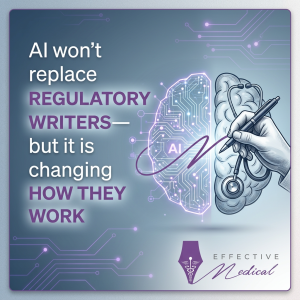
Artificial intelligence can accelerate drafting and data analysis, but in regulated environments, scientific accuracy, regulatory compliance, and expert judgement remain essential.
The real opportunity is combining technology with experienced medical writers who understand global regulatory expectations.
At Effective Medical, we believe AI should enhance expertise—not replace it.
What role do you think AI should play in regulatory writing?